...

Warehouse Epoxy Flooring New Jersey and Surrounding Areas

Warehouse Epoxy Flooring: The Solution for Durable and Efficient Flooring

Warehouse epoxy flooring provides great durability and creates an efficient workflow.

How does epoxy flooring improve warehouse operations?

This is achieved through using long-term patching materials that will tolerate high traffic and eliminate lost loads, while reducing forklift repairs

We mechanically abrade the surface using state-of-the-art grinding equipment, unlike the typical smaller grinders, which retain great down pressure creating the optimal glue line.

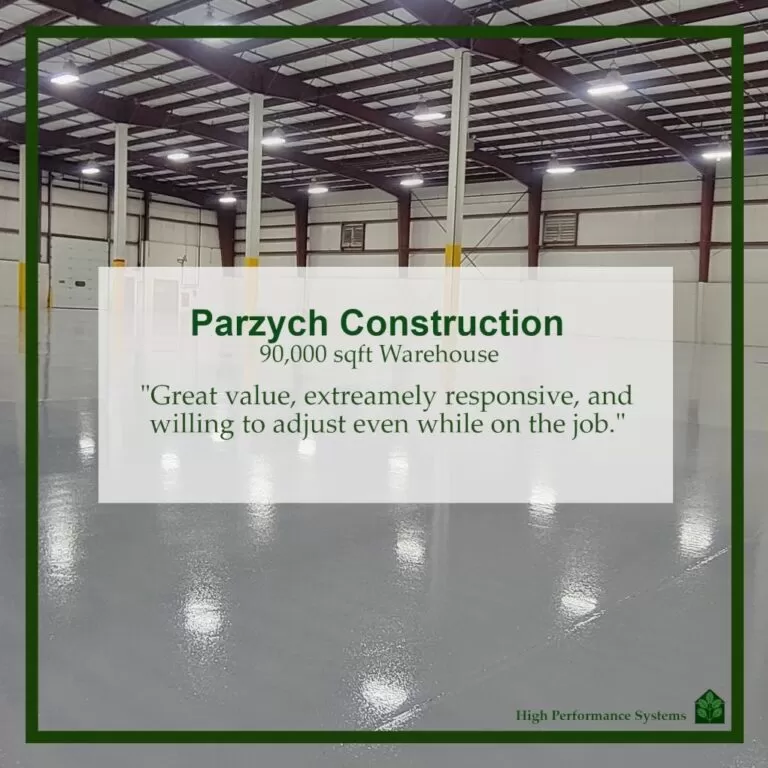
Warehouse epoxy flooring project with testimonial overlay and glossy finish
high performance flooring

Our 5-Step Industrial Epoxy Application Process.

Our epoxy flooring for a warehouse provides exceptional durability. Our preparation process is thorough and the foundation of a long-term solution.

We also resolve any uneven slabs and fill and eroded areas, making the substrate even for transporting loads without concern for tipping your products.

Using a HEPA vacuum system to minimize any airborne dust, we clean the prepared surface in preparation for our typically two-coat system.

We squeegee apply a heavy coat of high solids epoxy to build a heavy-duty wear coat, often including a non-skid additive that can be customized to your specific operations.

Finally, we apply a coat of aliphatic urethane to retain sheen and color while increasing scratch resistance.

Warehouse Resin Flooring Reduced Operational Costs

Warehouse resin flooring systems are designed to reduce operational costs while improving safety and durability.  Their seamless, non-porous surface resists impact, abrasion, and chemicals, significantly lowering maintenance and repair expenses over time.

These systems can be customized for specific warehouse environments, including additional slip resistance in high-traffic areas and chemical-resistant coatings for battery charging stations. Reflective finishes can also improve
lighting efficiency, contributing to a brighter, more productive workspace.
For warehouses and distribution centers that require durability, safety, and long-term value, epoxy and resin flooring systems provide a reliable, cost-effective solution.

Epoxy Flooring New Jersey

FAQs

How does epoxy flooring improve warehouse operations?

Warehouse epoxy flooring improves operations by using long-term patching materials that tolerate high traffic and eliminate “lost loads.” Creating a smoother, more durable surface, it helps reduce the frequency of forklift repairs and prevents product tipping caused by uneven or eroded slabs.

The process begins with mechanical abrasion using state-of-the-art grinding equipment to create an optimal “glue line” for bonding. After cleaning the surface with a HEPA vacuum system to minimize dust, a heavy-duty epoxy wear coat is squeegee-applied. Finally, an aliphatic urethane topcoat is added to retain color, sheen, and scratch resistance.

Resin flooring is considered a “gold standard” because its extreme durability leads to lower maintenance requirements. Protecting the underlying concrete substrate from wear and chemical damage, it reduces the overall life-cycle cost of the facility’s infrastructure.

Yes. Safety can be enhanced by adding non-slip additives to high-traffic or moisture-prone areas to increase traction. Additionally, these systems can be customized with chemical-resistant properties specifically for battery charging stations or other hazardous zones.

Absolutely. High-performance epoxy coatings have reflective properties that enhance workspace lighting. This improved visibility makes the environment more convenient for workers and can help reduce energy costs by maximizing the effectiveness of existing overhead lights.

The curing time for warehouse epoxy depends on the specific system and environment, but generally, you can follow this timeline for standard industrial-grade coatings:

  • Foot Traffic: 12 to 24 hours.

  • Light Traffic (e.g., light carts): 24 to 48 hours.

  • Heavy Traffic & Forklifts: 72 hours (3 days).

  • Full Chemical Cure: 7 days.

Factors That Affect Cure Time

  • Temperature: Epoxy cures through a chemical reaction. Warmer temperatures (above 70°F) speed up the process, while cold temperatures can significantly delay it or even stop the reaction entirely.

  • Humidity: High humidity can lead to “amine blush” or a cloudy finish, affecting the surface’s final integrity.

  • Product Type: Fast-set or polyaspartic systems can often be returned to service in as little as 4 to 6 hours, whereas standard high-solids epoxy takes longer.

Note: Even if the floor feels dry to the touch within 10 hours, it is vital to wait the full 72 hours before allowing heavy machinery or forklifts to operate. Driving on a floor that hasn’t reached its full compressive strength can lead to permanent indentations or delamination.

For high-volume forklift traffic, the “best” flooring isn’t just about the top layer—it’s about the compressive strength of the entire system. Forklifts exert massive “point loads” on small contact areas, meaning the floor must resist both crushing and abrasion.

The top industry choices for these environments are:

1. High-Solids Epoxy with Quartz or Sand Broadcast

This is the standard for most warehouses. By broadcasting aggregate (like silica sand) into a thick high-solids epoxy base, you create a “slurry” or “multilayer” system that is significantly harder than a simple roll-on coating.

  • Why it works: The aggregate helps distribute the weight of the forklift and provides the grip needed for sudden stops.

2. Urethane Concrete (Cementitious Urethane)

While often associated with food processing, urethane concrete is arguably the most durable option for heavy industrial use.

  • Why it works: It has a similar thermal expansion coefficient to the concrete slab beneath it. It won’t delaminate under the heat generated by spinning forklift tires or the heavy vibration of heavy loads.

3. Polished Concrete with Penetrating Hardeners

For massive distribution centers where chemical spills aren’t a concern, polished concrete treated with lithium densifiers is a popular choice.

  • Why it works: The densifier reacts chemically with the concrete to “close” the pores, making the surface extremely hard and dust-proof. It’s the most cost-effective for millions of square feet but offers less impact protection than resinous systems.


Crucial Comparison for Forklift Areas

FeatureEpoxy SlurryUrethane ConcretePolished Concrete
DurabilityHighVery HighMedium-High
Grip/TractionCustomizableExcellentModerate (can be slick)
Impact ResistanceGoodExcellentFair
Downtime24–72 hours