...

Philly Warehouse Epoxy Flooring & Concrete Repair

Industrial Warehouse Epoxy & Urethane Cement Flooring Solutions

The Greater Philadelphia region has solidified its position as a premier East Coast logistics and industrial powerhouse. Driven by the explosive growth of e-commerce fulfillment along the I-95, I-276, and I-476 corridors, local facilities face non-stop operational pressure.

To maintain 24/7 velocity, the absolute foundation of your operation—the concrete floor slab—must perform flawlessly. Unprotected concrete quickly breaks down under the punishing forces of constant forklift traffic, heavy static pallet loads, and structural impacts, leading to joint spalling, deep cracking, and hazardous concrete dust. For industrial facility managers across Southeastern Pennsylvania, high-performance resinous flooring systems are a structural requirement to keep operations moving safely and efficiently.

Industrial flooring is not a one-size-fits-all application. Different sectors across the Philly metro and Lehigh Valley regions demand specialized chemical and physical properties to maximize the lifespan of their floors:

King of Prussia: Pharmaceutical & Advanced Manufacturing

As a dominant hub for biopharmaceutical manufacturing, life sciences, and high-tech R&D, King of Prussia facilities require flawless environmental control and sterile processing zones.

  • The Challenge: Harsh chemical sanitization protocols, strict FDA/GMP compliance, and the need to prevent any microbial harboring.

  • The Solution: Seamless, high-gloss self-leveling epoxy or polyaspartic systems integrated with a vertical cove base. These systems are completely non-porous, leaving zero cracks or joints where bacteria or moisture can hide, and can withstand aggressive washdowns.

Dustless diamond grinding concrete edges along a warehouse wall header to ensure seamless resinous floor adhesion.
Heavy duty chemical resistant epoxy mortar floor coating applied in a Norristown PA industrial manufacturing shop.

Bensalem: High-Volume Logistics & 3PL Hubs

Positioned perfectly along the I-95 and PA Turnpike corridors, Bensalem’s massive distribution parks experience relentless, 24/7 forklift traffic and rapid inventory turnover.

  • The Challenge: Extreme wheel abrasion, deep gouges from pallet staging, tire marking, and concrete dust control.

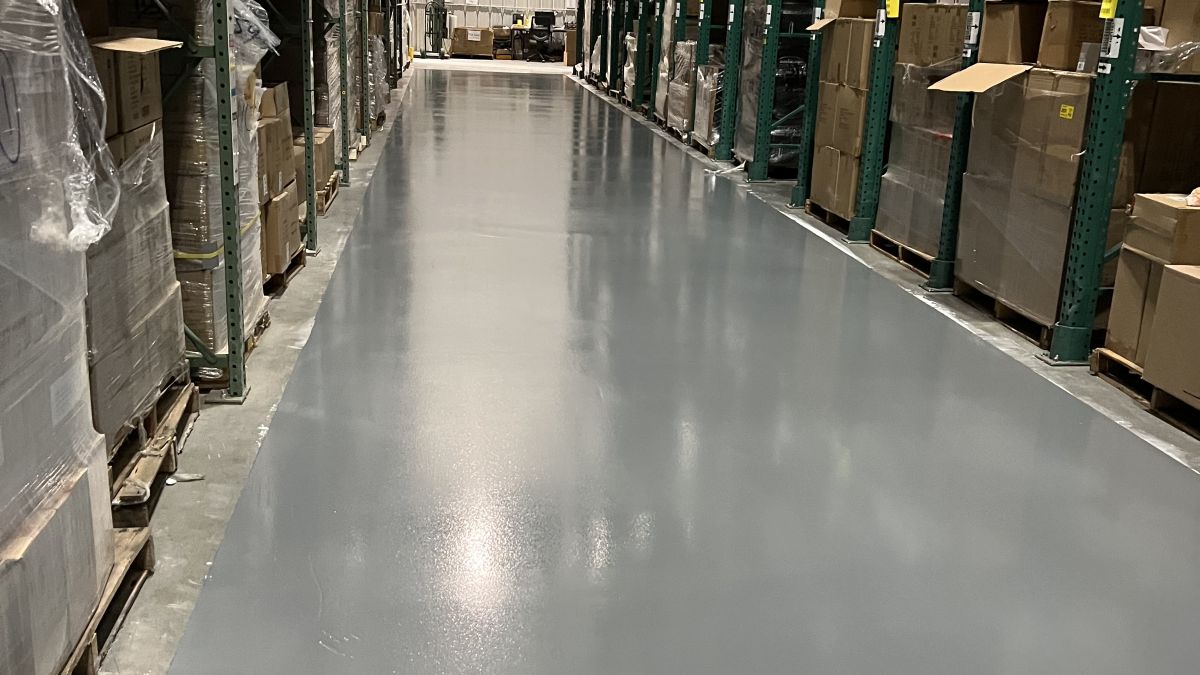
  • The Solution: High-build, 100% solids industrial epoxy systems topped with a premium aliphatic polyurethane wear-layer. This specialized system provides superior abrasion resistance, eliminates concrete dusting, and reflects overhead LED lighting to maximize worker safety.

Norristown: Heavy Industrial & Fleet Maintenance

Norristown’s industrial landscape features a mix of heavy manufacturing, machining operations, and commercial fleet maintenance facilities.

  • The Challenge: Frequent exposure to automotive fluids, aggressive lubricants, chemical spills, and heavy tool drop impacts.

  • The Solution: High-strength Epoxy Mortar and Slurry Systems finished with chemical-resistant Novolac topcoats. This builds a dense, impenetrable barrier that prevents hazardous fluids from soaking into the porous concrete, protecting the structural integrity of the slab.

High build industrial warehouse epoxy flooring handling heavy forklift traffic in a Bensalem PA logistics hub.
Heavy duty chemical resistant epoxy mortar floor coating applied in a Norristown PA industrial manufacturing shop.

Bethlehem: Massive Fulfillment Centers & Manufacturing

The historic industrial corridors of Bethlehem have transformed into a sprawling hub for mega-sized fulfillment centers, cold storage chains, and heavy manufacturing.

  • The Challenge: Drastic temperature drops in blast freezers, thermal shock during hot-water washdowns, and extreme static loads from high-density racking.

  • The Solution: Urethane Cement (Polyurethane Concrete). Standard epoxy coatings become brittle and delaminate under extreme thermal shifts. Urethane cement expands and contracts at a rate identical to the concrete slab beneath it, easily handling thermal shock from sub-zero freezers up to hot washdown temperatures.

Optimizing Facility Safety and Traffic Efficiency

A properly engineered industrial floor actively optimizes daily warehouse operations beyond just protecting the concrete substrate:

  • Permanent Safety Line Striping: Embed crisp safety lanes, pedestrian paths, forklift corridors, and staging zones directly beneath the clear industrial wear-layer. This ensures your safety layouts never scratch off, peel, or fade under heavy wheel traffic.

  • Customized Slip Resistance: Systems can be customized by zone—from ultra-smooth finishes for rapid sweeping in dry fulfillment zones, to aggressive aluminum oxide or quartz aggregate broadcasts in wet loading docks or washdown bays.

  • Sanitary Seamless Transitions: Incorporating an integral vertical cove base molding allows the resinous floor to transition seamlessly up the wall, eliminating the tight corners where dirt, dust, and moisture gather.

Are you looking to price out a specific industrial layout in the Greater Philadelphia or Lehigh Valley area, or do you need to address an ongoing concrete dusting or floor failure problem in your facility?

FAQs

How much operational downtime should our facility expect during an epoxy or urethane cement installation?

Minimizing supply chain disruption is our priority. While standard 100% solids epoxy systems require 48 to 72 hours to fully cure for heavy forklift traffic, we specialize in rapid-cure systems for high-velocity 24/7 hubs. Using advanced polyaspartics or quick-turn urethane cements, we can have your floor fully ready for structural wheel loads in as little as 12 to 24 hours, allowing us to complete installations over a standard weekend shutdown.

Industrial concrete slabs in heavy manufacturing areas like Norristown and logistics hubs in Bensalem endure extreme mechanical stress that weak surface prep cannot support. We utilize heavy-duty 800-pound planetary diamond grinders and shot-blasting machinery to aggressively profile the substrate (achieving a CSP 3 to 5). This process completely strips away old sealers, deep oils, and weak laitance, ensuring the new resin forms an unbreakable mechanical bond that will not peel or delaminate.

High moisture vapor transmission (MVT) is a frequent issue for industrial slabs situated near regional waterways and low-lying tables. Before applying any coatings, we conduct rigorous relative humidity (RH) testing on the slab. If elevated moisture levels are present, we apply a specialized moisture vapor barrier primer that withstands up to 99% RH, sealing the substrate and protecting the subsequent epoxy or urethane topcoats from blistering.

Yes. Applying an industrial coating over damaged concrete will quickly result in floor failure. We use dustless diamond saws to route out all structural cracks and fill them flush with high-strength epoxy mortars. For spalled expansion joints, we rebuild the broken joint shoulders and install a semi-rigid polyurea joint filler. This completely protects the joint edges from snapping under rigid forklift wheels while still allowing the independent concrete slabs to move naturally.

For heavy logistics and cold storage hubs in Bethlehem, Urethane Cement (Polyurethane Concrete) is the industry standard. Standard epoxy coatings become brittle, crack, and delaminate when subjected to extreme sub-zero temperatures or thermal shock from hot-water washdowns. Urethane cement expands and contracts at the exact same rate as the underlying concrete slab, entirely eliminating thermal shock failure while maintaining strict USDA/FDA compliance.