...

Demands on Warehouse Epoxy Flooring in Southern NJ’s Logistics Corridors

Serving Swedesboro, Vineland, Cherry Hill, and Gloucester City

Southern New Jersey has rapidly transformed into one of the most critical distribution and industrial development corridors in the Mid-Atlantic region. Driven by expansive logistics parks along the I-295 corridor and Route 55, Southern NJ facilities handle intense freight volumes, massive agricultural distribution, and port-centric heavy manufacturing.

To keep these high-volume facilities operating safely and efficiently, the concrete floor slab must withstand relentless punishment. Continuous forklift traffic, heavy pallet loads, and temperature fluctuations can quickly break down unprotected concrete—leading to spalling joints, structural cracks, and hazardous concrete dust. For industrial operators across Southern New Jersey, high-performance resinous flooring systems are a foundational requirement for operational longevity.

The operational demands on warehouse flooring vary significantly by submarket and sector. Industrial epoxy and polyurethane systems must be engineered specifically to withstand these local facility challenges:

Swedesboro: High-Velocity Logistics & Pure Distribution

As a premier tri-state e-commerce and logistics hub, Swedesboro’s massive industrial parks experience constant, 24/7 forklift movement and rapid inventory turnover.

  • The Challenge: Severe wheel wear, deep gouges from pallet staging, tire marking, and concrete dust control.

  • The Solution: High-build, 100% solids industrial epoxy systems topped with a premium aliphatic polyurethane wear-layer. This specialized system provides superior abrasion resistance, eliminates concrete dusting, and reflects overhead LED lighting to create a brighter, safer workspace.

Heavy duty 800 pound planetary diamond grinder mechanically preparing concrete substrate profile for permanent industrial epoxy bond.
Routing and widening concrete warehouse floor cracks using a dustless diamond blade saw before epoxy injection.

Vineland: Food Processing & Agricultural Cold Storage

Vineland sits at the heart of South Jersey’s massive food processing, cold chain logistics, and agricultural distribution network.

  • The Challenge: Extreme temperature drops in blast freezers, thermal shock during hot-water washdowns, organic acids, and strict USDA/FDA sanitation rules.

  • The Solution: Urethane Cement (Polyurethane Concrete). Unlike standard epoxy coatings which become brittle and delaminate under extreme temperature shifts, urethane cement expands and contracts at a rate identical to the concrete slab beneath it. It is seamless, non-porous, and completely resists microbial growth.

Gloucester City: Port Logistics & Heavy Industrial

Proximity to the Delaware River ports means Gloucester City facilities manage heavy industrial manufacturing, bulk cargo handling, and maritime logistics.

  • The Challenge: Impact damage from heavy machinery drop zones, severe concrete pitting, and heavy static pallet loads.

  • The Solution: Aggregate-filled Epoxy Mortar and Slurry Systems. These high-strength, hand-troweled or slurry-cast systems rebuild eroded concrete substrates and dramatically boost the compressive strength of the floor to absorb structural impacts.

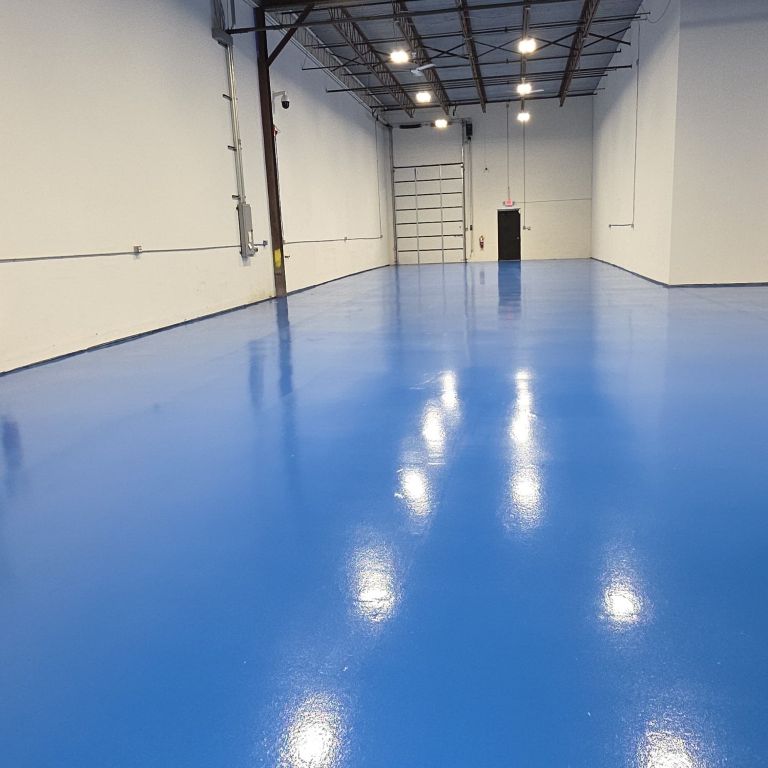
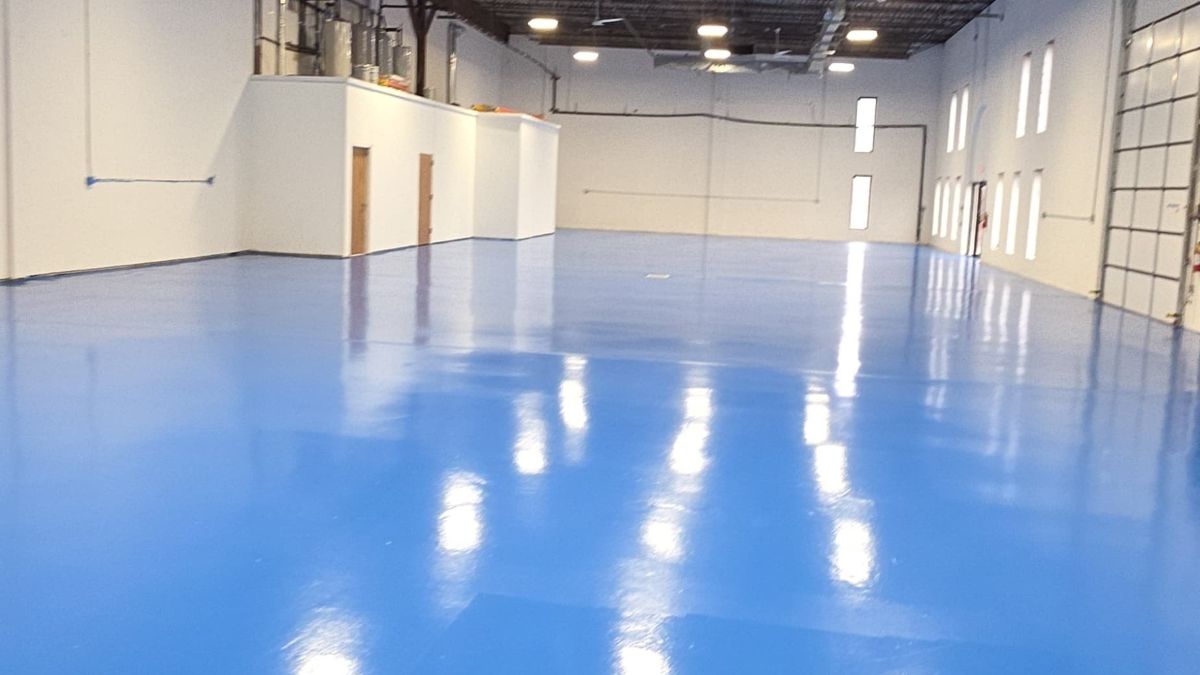
Heavy duty industrial warehouse epoxy flooring with high gloss finish in a Southern New Jersey distribution center.

Cherry Hill: Commercial Hubs & Fleet Maintenance

The Cherry Hill submarket features a mix of corporate distribution, specialized fleet maintenance facilities, and high-end commercial infrastructure.

  • The Challenge: Chemical exposure to oils, fluids, and lubricants, coupled with the need for clean, professional aesthetics.

  • The Solution: Chemical-resistant epoxy primers and topcoats engineered to stop hazardous fluids from penetrating the porous concrete, preventing environmental staining and maintaining structural durability.

Optimizing Facility Safety and Traffic Efficiency

A properly engineered industrial floor actively optimizes daily warehouse operations beyond just protecting the concrete substrate:

  • Permanent Safety Line Striping: Embed crisp safety lanes, pedestrian paths, forklift corridors, and staging zones directly beneath the clear industrial wear-layer. This ensures your safety layouts never scratch off, peel, or fade under heavy wheel traffic.

  • Customized Slip Resistance: Systems can be customized by zone—from ultra-smooth finishes for rapid sweeping in dry fulfillment zones, to aggressive aluminum oxide or quartz aggregate broadcasts in wet loading docks or washdown bays.

  • Sanitary Seamless Transitions: Incorporating an integral vertical cove base molding allows the resinous floor to transition seamlessly up the wall, eliminating the tight corners where dirt, moisture, and bacteria gather.

Are you looking to price out a specific industrial layout in South Jersey, or do you need to address an ongoing concrete dusting or floor failure problem in your facility?

FAQs

How long does it take for a warehouse epoxy or urethane cement floor to cure before forklifts can drive on it?

Minimizing operational downtime is critical for South Jersey’s high-velocity distribution centers. While standard 100% solids epoxy systems generally require 48 to 72 hours to fully cure for heavy forklift traffic, we offer specialized fast-cure polyaspartics and rapid-cure urethane cements. These high-performance systems can accept full structural wheel loads in as little as 12 to 24 hours, allowing installations to be completed over a single weekend shift.

Industrial environments endure extreme wheel stress that chemical etching simply cannot support. We utilize heavy-duty, 800-pound planetary diamond grinders and shot-blasting machinery to mechanically prepare the concrete. This process strips away old sealers, deep oils, and weak surface laitance, achieving a clean, porous Concrete Surface Profile (CSP 3 to 5) that guarantees an unbreakable, permanent mechanical bond with the new resin.

Due to the low-lying geography and high water tables near the Delaware River ports and coastal submarkets, moisture vapor transmission is a major cause of floor blistering. Before applying any coatings, we conduct rigorous relative humidity (RH) testing on the slab. If elevated moisture levels are present, we install an industrial moisture vapor barrier primer that withstands up to 99% RH, sealing the substrate and protecting your topcoats from delamination.

Yes. Coating over damaged concrete will only cause the new floor to crack. We route out all fractures using dustless diamond saws and patch them flush using high-strength epoxy structural mortars. For moving expansion joints, we rebuild the broken joint shoulders and fill them with semi-rigid polyurea joint fillers. This protects the joint edges from snapping under heavy forklift wheels while still allowing the concrete slabs to expand and contract naturally.

For the heavy agricultural and food logistics hubs in the Vineland area, Urethane Cement (Polyurethane Concrete) is the industry standard. Standard epoxy coatings become brittle and delaminate when exposed to extreme sub-zero temperatures or hot-water washdowns. Urethane cement expands and contracts at the same rate as the underlying concrete slab, eliminating thermal shock failure while maintaining strict USDA/FDA sanitation compliance.