...

Heavy-Duty Warehouse Epoxy Flooring Services in Central New Jersey

Central New Jersey is the heartbeat of the tri-state logistics corridor. With massive distribution hubs running 24/7 in high-density industrial zones, warehouse floors endure relentless punishment. Standard concrete quickly degrades under the stress of heavy traffic, leading to concrete dust, cracks, and safety hazards.

For facilities operating across major Central NJ logistics hubs—including Edison, Carteret, Cranbury, South Brunswick, and Avenel—specialized, industrial-grade seamless epoxy and resinous flooring systems provide the durability, safety, and longevity required to keep operations moving.

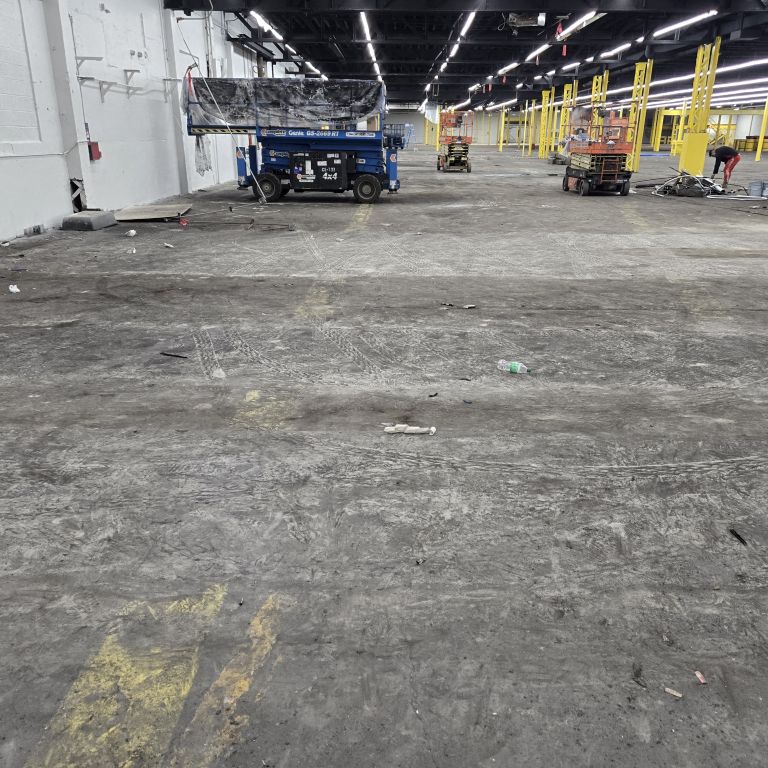
Unprepared, cracked concrete warehouse floor before industrial epoxy flooring installation in a Central Jersey logistics facility.
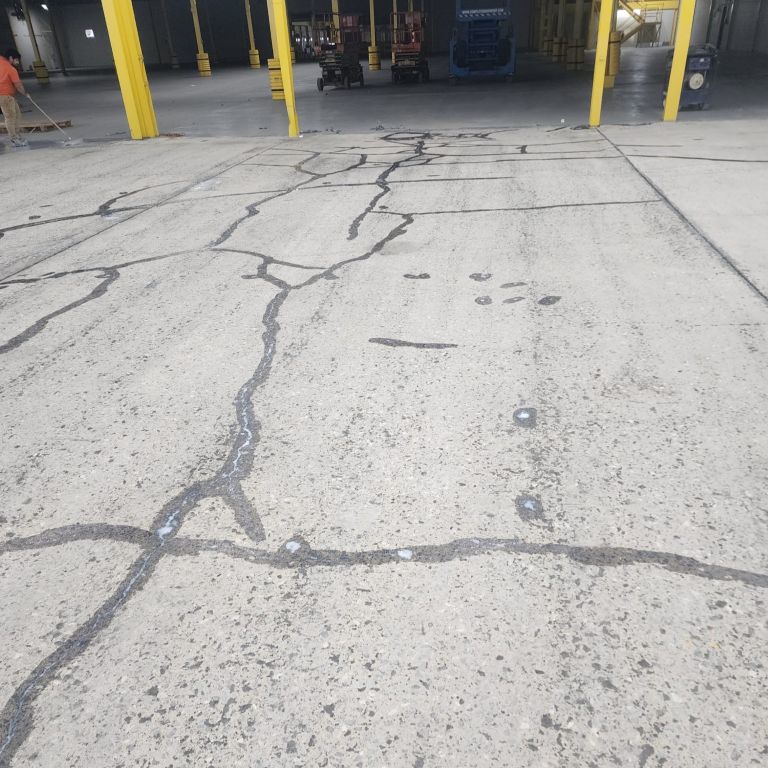
Severely cracked concrete warehouse floor requiring heavy-duty mechanical surface preparation before epoxy coating installation.

Targeted Solutions for Central NJ Logistics Hubs

Every industrial zone along the NJ Turnpike has its own unique facility demands. Resinous flooring solutions are tailored to meet the specific operational needs of these primary sectors:

Edison & Avenel: High-Volume Distribution & E-Commerce

Facilities in the Edison and Avenel/Woodbridge markets handle massive SKU turnover and constant forklift traffic.

  • The Challenge: Constant tire wear, abrasions, and the need for highly visible safety stripping.

  • The Solution: High-build, multi-layer epoxy flooring systems topped with an aliphatic urethane topcoat. This combination provides maximum abrasion resistance, prevents tire marking, and maintains a high-gloss reflection that optimizes overhead LED lighting.

Carteret: Port-Centric Logistics & 3PL Hubs

Proximity to the ports means Carteret facilities handle diverse freight, rapid turnover, and heavy structural loads.

  • The Challenge: Heavy wheel loads, impact risks from staging pallets, and concrete dust control.

  • The Solution: Heavy-duty slurry epoxy systems or aggregate-filled epoxy mortars. These systems reinforce the underlying concrete substrate, dramatically increasing its compressive strength to withstand static pallet loads and high-impact drop zones.

  • Cranbury & South Brunswick: Pharmaceuticals & Cold Storage

    The massive corridors along Exit 8A house complex pharmaceutical warehousing, food distribution, and temperature-controlled facilities.

    • The Challenge: Strict FDA/USDA compliance, frequent chemical washdowns, and thermal shock from cold storage environments.

    • The Solution: Urethane Cement (Polyurethane Concrete). Unlike standard epoxy, urethane cement expands and contracts at a rate similar to the concrete beneath it, preventing delamination in cold storage or freezer transitions. It is completely seamless, resisting the microbial growth required for FDA-regulated spaces.

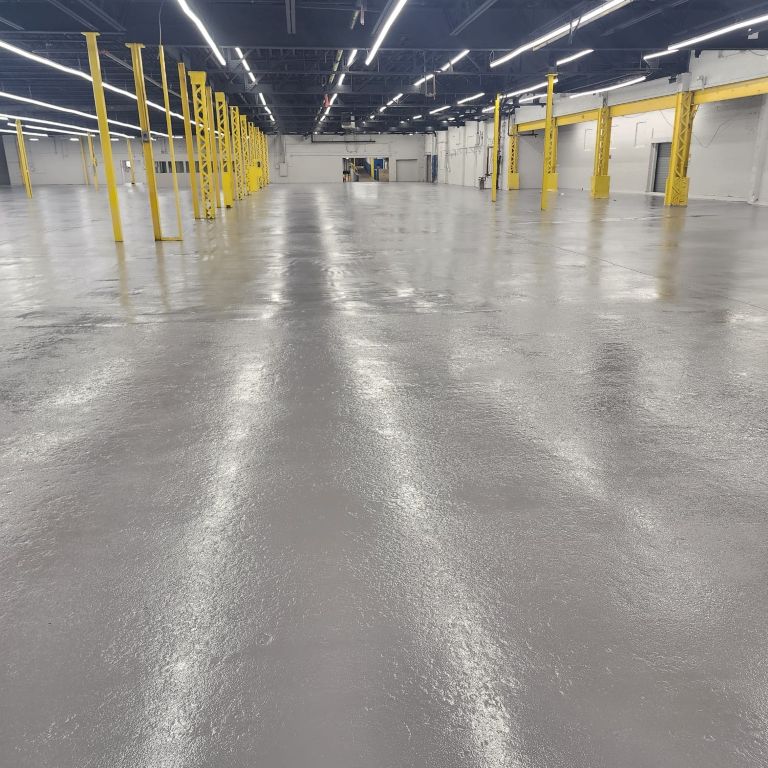
High-gloss industrial warehouse epoxy flooring installation in a Central Jersey facility featuring reflective seamless coatings and safety pillars.

The Core Process: Engineering a Floor Built to Last

An industrial epoxy floor is only as good as the mechanical bond it creates with the concrete substrate. Shortcuts in preparation inevitably lead to premature floor failure. A rigorous, uncompromising installation process ensures a permanent bond:

1. Heavy-Duty Mechanical Surface Preparation

Industrial installations require a clean, porous, and profiled concrete surface.

  • The Standard: Deployed heavy-duty, 800-pound planetary diamond grinders or shot-blasting equipment to remove existing sealers, curing compounds, and contaminants.

  • The Goal: Achieve a specific Concrete Surface Profile (typically CSP-3 to CSP-5) to guarantee the resin deeply penetrates and anchors into the concrete matrix.

2. Deep Substrate Repair & Joint Treatment

Warehouses cannot afford uneven joints or spelling cracks that damage forklift tires and create trip hazards.

  • All structural cracks, deep gouges, and spalled joints are routed out and filled with high-strength epoxy mortars.

  • Expansion joints are rebuilt and filled with semi-rigid polyurea joint fillers, protecting the edges from breaking under heavy wheel traffic while still allowing for natural slab movement.

3. Moisture Vapor Mitigation

Central New Jersey’s high water tables can cause osmotic blistering, where moisture vapor pushing up through the slab destroys the epoxy bond.

  • Prior to coating, the slab is tested for moisture emissions.

  • If elevated moisture levels are present, a specialized moisture-vapor-barrier primer is applied. This layer tolerates up to 99% relative humidity (RH), blocking moisture from the underlying layers and preventing delamination.

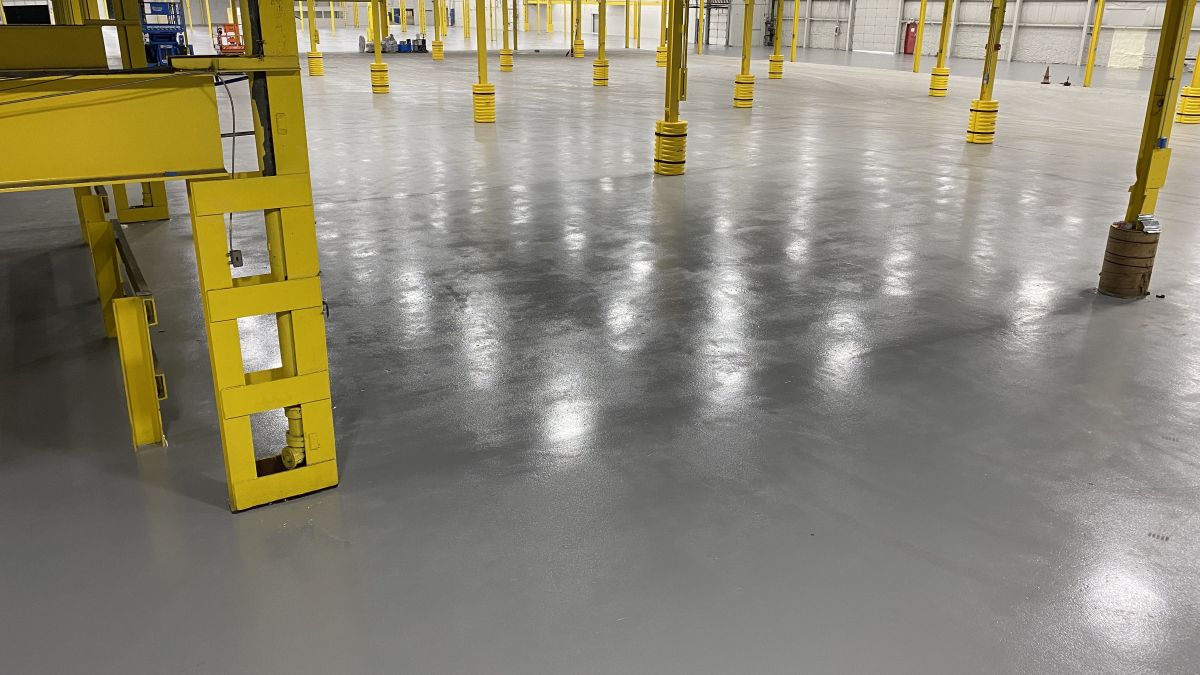
Industrial warehouse epoxy flooring installation in Central Jersey featuring a high-gloss, seamless finish and safety line striping layout.

Enhancing Safety and Operational Efficiency

A properly installed industrial floor does more than just protect the concrete slab; it actively optimizes facility operations:

  • Permanent Safety Line Striping: Safety walkways, pedestrian paths, forklift lanes, and “Keep Clear” staging zones can be painted and sealed directly beneath a clear industrial wear-layer. This ensures the lines never scratch off, peel, or fade under heavy traffic.

  • Customized Slip Resistance: Systems can be customized to match specific facility zones—from smooth, easily cleanable surfaces in high-velocity staging zones to aggressive aluminum oxide or quartz aggregate broadcasts in wet loading docks or washdown bays.

  • Seamless Hygienic Transitions: Incorporating an integral vertical cove base molding allows the flooring to transition seamlessly up the wall, eliminating the corners where dirt, dust, and moisture tend to accumulate.

Are you looking to price out a specific industrial layout, or do you need to address an ongoing concrete dusting or floor failure problem in your facility?

Note:

For facilities handling corrosive chemicals or forklift battery charging areas, a heavy-duty Chemical-Resistant Novolac Epoxy is required.

To handle extreme temperature shifts in cold storage and food processing zones, we recommend high-performance Urethane Cement Flooring Systems

FAQs

How long does a warehouse epoxy or urethane cement installation take to cure for forklift traffic?

Minimizing downtime is critical for Central NJ’s 24/7 logistics hubs. While standard epoxy systems typically require 48 to 72 hours to fully cure for heavy forklift traffic, we can install specialized fast-cure polyaspartic coatings or rapid-cure urethane cements. These advanced systems can accept full structural wheel loads in as little as 12 to 24 hours, allowing you to resume operations over a single weekend shift.

For industrial warehouses, chemical acid etching simply cannot achieve the deep profile needed to support heavy wheel traffic. We utilize heavy-duty, 800-pound planetary diamond grinders and shot-blasting equipment to mechanically profile the slab. This aggressive process completely strips away old sealers, curing compounds, and weak concrete, creating a high-grip Concrete Surface Profile (CSP 3 to 5) that guarantees a permanent, unbreakable mechanical bond with the new resin.

Because of the high local water tables across Middlesex and Somerset counties, moisture vapor pushing up through concrete slabs is a leading cause of floor blistering and delamination. Before applying any topcoats, we test the concrete’s relative humidity (RH) levels. If elevated moisture is detected, we install an industrial moisture vapor barrier primer that withstands up to 99% RH, completely sealing the slab and protecting your flooring investment.

Yes. Instead of using tape or standard paint that quickly scratches off under heavy forklift traffic, we embed crisp safety lines, pedestrian walkways, forklift lanes, and staging zone markings directly into the flooring system. These lines are painted onto the base coats and sealed beneath a heavy-duty, high-performance clear urethane wear-layer, ensuring they remain highly visible and scratch-resistant for years.

For the massive pharmaceutical and cold-storage corridors near Exit 8A (Cranbury, South Brunswick, and Monroe), Urethane Cement (Polyurethane Concrete) is the industry standard. Unlike standard epoxy, which can become brittle and delaminate under extreme temperature shifts, urethane cement expands and contracts at a rate identical to the underlying concrete. It easily handles thermal shock from deep freezers, resists harsh chemical washdowns, and maintains full FDA/USDA compliance.