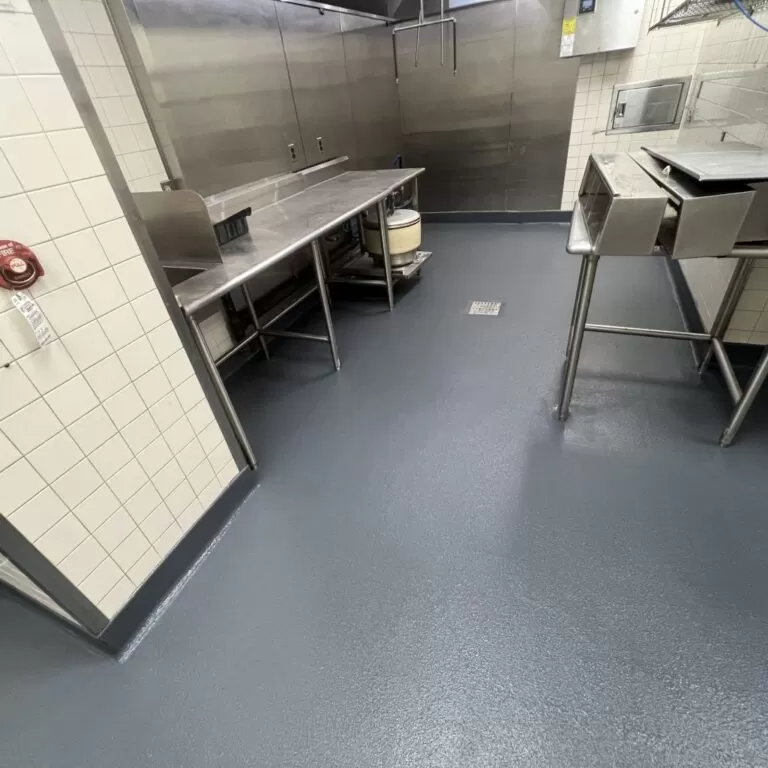
Urethane Concrete Flooring for the Food Service Industry
Industrial floor coating systems must meet the absolute highest standards of safety, durability, and hygiene when installed within commercial kitchens, commissaries, and food preparation environments. The food service industry operates under relentless conditions—ranging from extreme thermal shock during washdowns to constant exposure to corrosive organic acids, fats, and oils. Standard flooring options simply cannot survive these demands, leading to cracks, bacteria growth, and costly compliance failures.
To maintain an unyielding defense against microbial growth while ensuring a slip-resistant workspace, high-performance urethane concrete is the industry benchmark.
Why Urethane Concrete is Essential for Food Service
Unlike standard epoxy, urethane concrete expands and contracts at a rate similar to the underlying concrete substrate. This thermal compatibility prevents delamination during high-temperature steam cleaning or sudden temperature drops in walk-in freezers.
SQF & USDA Compliance: Seamless, non-porous installations eliminate grout lines and joints where bacteria, mold, and pathogens hide, effortlessly meeting stringent FDA, USDA, and SQF (Safe Quality Food) standards.
Thermal Shock Resistance: Built to withstand radical temperature fluctuations ranging from freezing storage conditions to boiling water washdowns.
Chemical & Acid Resistance: Superior protection against harsh sanitizing agents, citrus juices, animal fats, and lactic acids that typically erode weaker floors.
Enhanced Slip Resistance: Customizable aggregate broadcasts provide critical traction to protect your staff in inherently wet or greasy environments.
Precision Substrate Preparation: Urethane Concrete Flooring
A high-performance flooring system is only as good as the surface profile beneath it. We do not rely on lightweight prep methods that lead to premature floor failure. Every project begins with heavy-duty substrate preparation, providing the manufacturer’s specification to mechanically profile the concrete. This rigorous process removes contaminants, opens the concrete pores, and guarantees a permanent mechanical bond for the urethane cement system.
Custom Specifications for Food Service Zones
| Zone | Requirements | Recommended System |
| Commercial Kitchens & Cook Lines | High thermal shock, heavy grease, wet processing | Heavy-Duty Urethane Cement slurry with aggregate broadcast & chemical-resistant topcoat |
| Walk-In Freezers & Coolers | Sub-zero temperatures, constant moisture | Low-temperature cure urethane concrete |
| Dry Storage & Warehousing | Heavy pallet jack traffic, impact resistance | High-build industrial warehouse floor coating with high gloss finish |
| Loading Docks & Waste Areas | Heavy impact, severe abrasion, outdoor exposure | UV-stable, high-tensile urethane concrete system |
FAQs
How does urethane concrete differ from standard epoxy?
While epoxy acts as a tough plastic shield, urethane concrete is engineered as a super-strong, flexible “rubber armor.” Itis made by mixing liquid urethane resin with a special cementitious powder, combining the toughness of concrete with the high-tech chemical and abrasion resistance of urethane.
Can this flooring withstand extreme temperature changes?
Yes. One of its “superhero traits” is thermal stability. Urethane concrete can handle extreme thermal cycling from -40°F to over 200°F without softening, cracking, or delaminating. This makes it the ideal choice for food processing plants and commercial kitchens that require frequent hot-water washdowns.
Why is it recommended for high-impact industrial areas?
Urethane has incredible impact resistance. Unlike rigid concrete or thin epoxy that might crack when a heavy tool or pallet is dropped, urethane concrete has a bit of “give.” It absorbs and dissipates the energy, bouncing back without the chipping or spalling often seen in lesser materials.
How does it improve safety and hygiene in production areas?
These systems are seamless and non-porous, meaning bacteria, moisture, and grime have nowhere to hide. They can also be formulated with non-slip aggregates to ensure a slip-resistant surface even when the floor is wet or oily, helping New Jersey facilities maintain high sanitary and safety standards.
Is the higher initial investment worth it?
While the upfront cost is higher than a simple coating, it is considered a “premium solution for premium problems.” By eliminating the need for constant repairs and preventing unplanned production downtime, urethane concrete provides long-term operational continuity, often lasting years longer than standard epoxy systems.