...

Epoxy Flooring For Restaurants: USDA-Compliant Solutions

Why Choose Epoxy for Your Restaurant?

Operating a high-volume commercial kitchen demands a flooring system engineered to withstand relentless punishment. Between heavy daily foot traffic, thermal shock from cooking equipment, and corrosive organic fats, traditional quarry tile and standard sealants inevitably fail. At High Performance Systems, we deliver seamless, heavy-duty resinous solutions designed to pass strict health inspections with ease. (Commercial and industrial marketplace only; no residential inquiries, please.)

usda fda

USDA / FDA Compliant

slip resistant

Custom Non-Slip Textures

cold storage

Thermal Shock Resistant

Heat & Thermal Shock Resistance: Epoxy Flooring for Restaurants

Standard restaurant epoxy flooring easily handles temperatures ranging from 150°F to 300°F, outperforming traditional tile and grout in daily washdown cycles. For extreme environments requiring constant hot-water sanitation, we install specialized urethane cement systems engineered to expand and contract at the exact same rate as concrete—preventing cracking, delamination, and thermal shock failure.

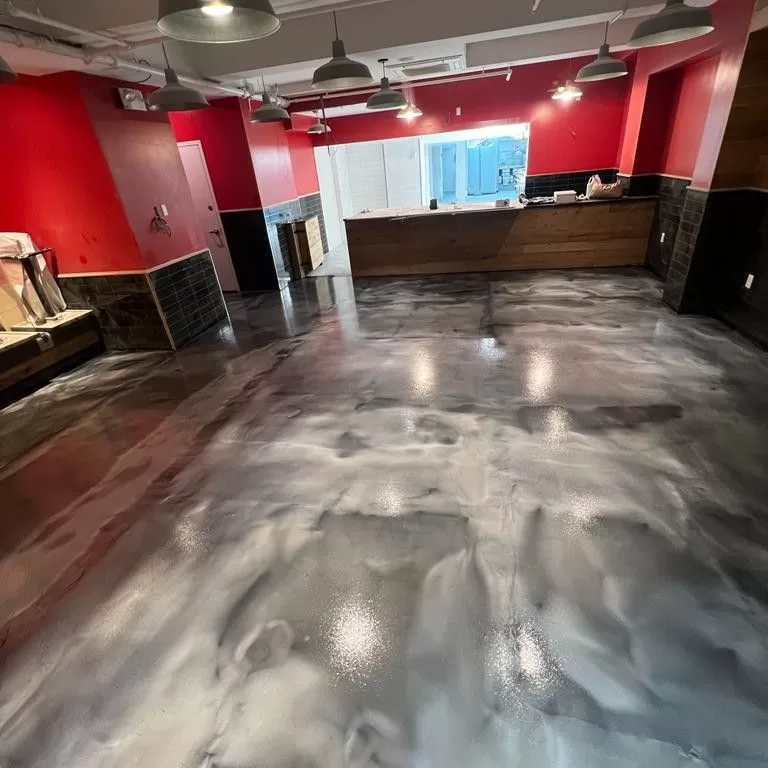
Decorative metallic restaurant epoxy flooring with a high-gloss seamless finish in a modern dining area.
Designer restaurant epoxy flooring by High Performance Systems, featuring a durable, light-reflective resin coating.

Epoxy Flooring For Restaurants: Fast Installation and Minimal Downtime

With over 40 years of experience serving the Tri-state area and Virginia, we’ve perfected the art of off-hour installations to ensure your restaurant never misses a shift.

We understand that epoxy flooring for restaurants creates a nightmare for business owners.

How do you reduce downtime when installing restaurant epoxy flooring? We excel in the restaurant business as we offer a series of different resins that allow us to reduce our timelines and minimize any lost business.

It is not uncommon for us to do flooring in sections. We also offer off-hour services to work with our customers’ needs.

In addition, we also offer dining area restaurant epoxy flooring that creates the ambient mood of your culinary vision.

The Correct Restaurant Epoxy Flooring?

Choosing the right restaurant epoxy flooring is an investment in your facility’s long-term safety, hygiene, and operational efficiency. With the intense demands of constant foot traffic, extreme temperatures, and strict health inspections, you need a surface that doesn’t just look professional but performs under pressure.

FAQs Abour Epoxy Flooring For Restaurants

Is epoxy flooring really "food-safe"?

Yes. High-performance epoxy and urethane cement systems are completely seamless and non-porous. This eliminates the grout lines and hairline cracks where bacteria, mold, and pathogens hide, ensuring full compliance with USDA, FDA, and HACCP regulations.

Standard epoxy can sometimes struggle with extreme thermal shock (like hot oil spills or power washing with boiling water). However, specialized Urethane Concrete or high-temperature epoxy systems are specifically engineered to expand and contract at the same rate as the concrete beneath them, preventing the floor from cracking or peeling under high heat.

Absolutely. Safety is a top priority in busy restaurants. During the installation process, various aggregates (like quartz or sand) can be broadcast into the epoxy to create a textured, anti-slip surface. This provides necessary traction for staff moving quickly, even if there is water or grease on the floor.

As experienced commercial and industrial flooring contractors, we coordinate work around your operating hours and shift changes. We frequently complete installations in strategic phases or overnight so your kitchen never misses a shift.

Yes, in many cases. If the existing quarry tile or ceramic tile is still well-bonded to the concrete, it can be professionally ground down and prepared to accept an epoxy coating. This saves the owner the time and massive expense of a full floor demolition, though a direct inspection is always required to ensure the base is stable.