...
thermal shock resistant flooring

Thermal Shock Resistant Flooring: Why It's Crucial for Food Production Areas

Ever watch a sturdy dinner plate crack when it goes from a hot oven into a cold sink? That’s thermal shock in action. Now, imagine that the violent stress of rapid, extreme temperature change is working relentlessly on your facility’s floors, day after day. In kitchens, breweries, food processing plants, and cold storage areas, this isn’t a hypothetical. It is a daily, destructive reality that can turn a critical investment into a costly, crumbling liability.

Forget aesthetics for a moment. The true test of a floor in these environments isn’t just about spills or heavy loads. It’s about surviving the brutal, invisible war between scalding heat and cold without failing. Let’s break down why this specific performance characteristic isn’t just a nice-to-have; it’s the non-negotiable foundation for safety, sanitation, and operational continuity in 2026.

thermal shock resistant flooring

The Silent Saboteur in Your Facility

Thermal shock occurs when a material expands or contracts too quickly due to a sudden temperature shift. Most standard floors, even some industrial epoxies, are rigid. They can’t handle the flex. The result?

Hairline cracks appear first, often dismissed as cosmetic.

Moisture and bacteria invade these microscopic openings. This is where your sanitation protocol fails at the ground level, literally.

Delamination follows, where the flooring material peels away from the concrete slab beneath.

Ultimately, complete system failure creates trip hazards, forces emergency shutdowns, and leads to six-figure replacement projects.

The financial bleed isn’t just from the repair. It’s from the downtime. It’s from a production line halted. It’s from a failed health inspection. In today’s operational landscape, that kind of disruption is a direct threat to your bottom line and reputation.

thermal shock resistant flooring

Beyond Basic Epoxy: The Right Material for the Fight

Knowing the problem is half the battle. The other half is specifying a solution built for this specific fight. Not all “chemical-resistant” or “durable” floors are created equal for thermal shock resistant flooring.

A common misconception is that a thick, rigid epoxy is the ultimate armor. In reality, its very rigidity can be its weakness under thermal stress. The industry answer, and what we’ve seen succeed for decades, is a different class of material: urethane cement flooring systems.

Here’s why these matters:

Engineered Flexibility: Urethane cement has a lower modulus of elasticity. In plain terms, it’s tough but has a bit of “give.” It moves with the concrete substrate during temperature swings instead of fighting against it.

Seamless Impermeability: When installed correctly, it forms a monolithic, joint-free surface. No cracks mean no harborage points for ListeriaE. coli, or mold. Your aggressive hot-water and chemical wash-downs become a feature, not a threat.

Rapid Thermal Cycling Endurance: It can handle the direct transition from a 180°F hot water wash to a 35°F chill from frozen goods. Daily. Without complaint.

thermal shock resistant flooring

A Real-World Test: The Tofu Processor Challenge

A case study from a major Midwest tofu processor sticks in my mind. Their previous floor failed in under two years. Every day, production involved steam, hot blanching water, and rapid cooling. The thermal cycling was relentless.

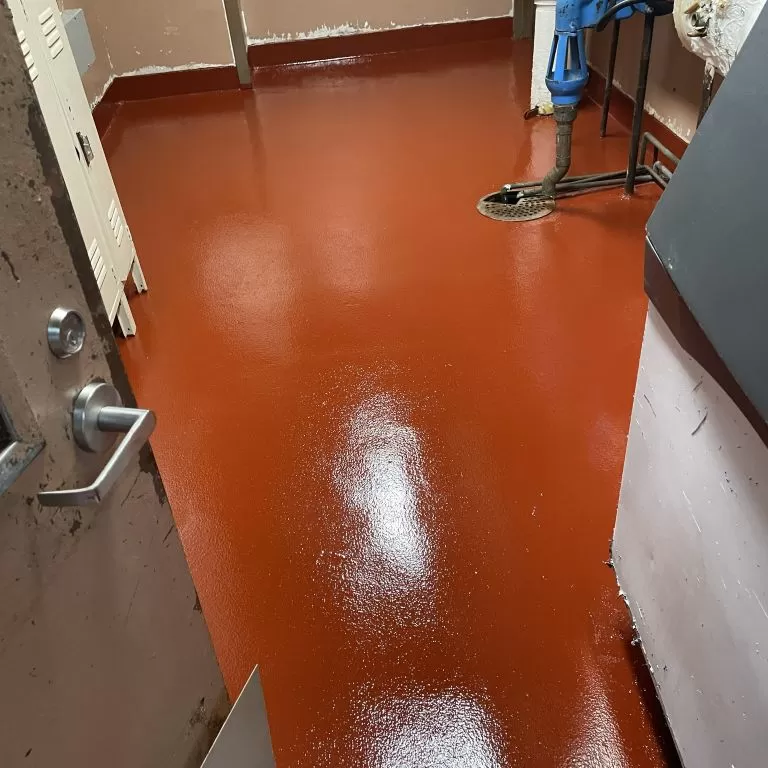
The failure point was always at the joints and cracks. Sanitation was a constant losing battle. We specified and installed a heavy-duty urethane cement system, which was an excellent thermal shock resistant flooring system. That was over seven years ago. The floor is still intact, seamless, and passing microbial swab tests with ease. The key wasn’t just replacing the floor; it was matching the wrong material with the right one for the actual physical stress present. The return on investment was calculated not in years of life, but in uninterrupted production days and risk mitigation.

thermal shock resistant flooring
Building a Floor That Lasts: The Installation Imperative

Even the perfect material can fail if installed incorrectly. Specifying urethane cement is the first step. The second is ensuring the installation process is just as robust. This isn’t a weekend DIY project.

Critical steps often overlooked include:

Concrete Substrate Diagnosis: Is there moisture vapor transmission? What’s the compressive strength? The current slab has to be professionally assessed.

Military-Grade Surface Preparation: This usually involves diamond grinding or shot blasting to achieve a specific profile. The bond is only as good as the surface it’s stuck to.

Precise, Environment-Controlled Installation: Temperature and humidity during installation are critical. The installers need to move with a mix of speed and precision that only comes from deep experience with these specific resins.

Cutting corners on prep or installation to save a few dollars per square foot is the surest way to guarantee a premature, total failure. The floor is a system, not just a coating

Your Next Move: Audit for Risk

Walk your production area today, not for a general inspection, but with a single focus: temperature extremes.

Trace the path from the cook tank to the cooling rack.

Look at the floor where the steam cleaner is used.

Examine the area in front of the blast chiller or freezer.

Those tiny cracks and hollow sounds aren’t minor flaws. They are thermal shock in action. The crack is the symptom; material incompatibility is the disease.

A true performance floor must be an active, reliable part of your production line, handling thermal stress as seamlessly as your HVAC. The best floor is one you forget because it simply works.

For three decades, High Performance Systems has engineered floors that withstand these exact forces. We diagnose the physics of failure to prevent it. The right floor exists. It starts with asking the right questions.

800-928-7220